Historic Homes for Sale: What Buyers Should Know Before Making an Offer
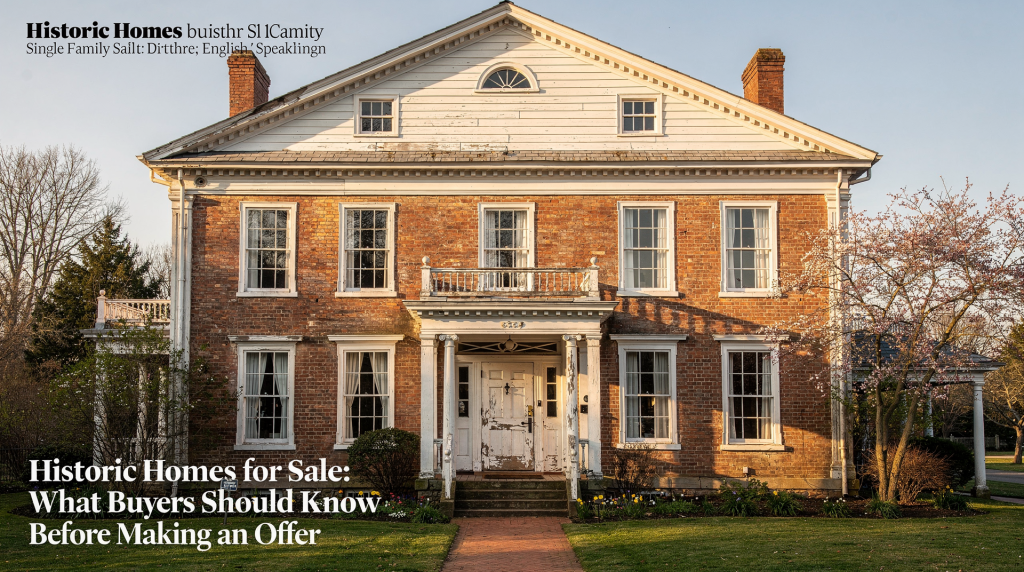
Buying a historic home is a different discipline from purchasing a standard resale property. The appeal is immediate—craftsmanship, original materials, a sense of continuity—but the risks are just as real. Before you make an offer, you need to understand the building’s condition, its legal protections, the likely repair costs, and the kind of ownership commitment you are actually taking on.
Why Historic Homes Require a Different Buying Strategy
A historic property can be exquisite and still be punishingly expensive to maintain. The fabric of an old house rarely lies: outdated wiring, original plumbing that has outlived its service life, insulation that amounts to little more than horsehair and hope, foundations that have settled over centuries, and the near-certain presence of lead paint or asbestos somewhere in the layers. The most common mistake is to judge the house by its façade and its fireplaces, rather than by its structure, its services, and the legal framework that surrounds it.
You are not simply purchasing rooms and acreage. You may also be acquiring:
- Original fabric that should be preserved
- Past alterations that need correction
- Historic designation rules
- Preservation easements or covenants
- Higher maintenance and specialist repair costs
That means the right offer is never the highest one you can justify emotionally. It is the one that still holds up after rigorous due diligence.
Step 1: Understand What Kind of Historic Property You’re Buying
Not all “historic homes” are the same. The term covers a wide spectrum, and the distinctions matter enormously when it comes to what you can alter, how you can finance the purchase, and what you will be able to sell on later.
Common categories
- Individually listed historic properties
- Homes inside a historic district
- Properties protected by preservation easements
- Older homes with no formal designation but architectural value
- Estates with land-use or conservation restrictions
Each category carries a different weight of regulation. An individually listed building may have every external detail—and sometimes internal ones—protected, while a house in a conservation area might only need approval for changes visible from the public road. A preservation easement, by contrast, is a private legal agreement that can be more restrictive than statutory listing.
What to check early
- Is the home officially designated?
- Is it in a local or national historic district?
- Does the title mention an easement or covenant?
- Are exterior changes subject to review?
- Are there interior restrictions as well as exterior ones?
Ask these questions before you even book a viewing. Too many buyers fall for a house only to discover afterwards that the windows they planned to replace are protected, or that the kitchen extension they imagined is prohibited by a covenant.
Step 2: Review the Title, Deed, and Restrictions Before You Offer
A title search is not a formality; it is the single most important piece of paper you will read before committing. It can reveal whether the property is burdened by a historic preservation easement, a restrictive covenant, or a conservation agreement. Your solicitor or title professional should specifically look for:
- Easements
- Covenants
- Deed restrictions
- Conservation agreements
- Recorded approvals or obligations
- Historic overlay requirements
Why this matters
These restrictions can touch almost every future project you might imagine: replacing windows, repairing or rebuilding porches, adding a dormer, changing exterior materials, altering interior features, building an extension, even excavating for drainage or landscaping. Some easements require prior approval for any alteration to historic fabric and may demand an archaeological watching brief before you so much as move soil. If your plans depend on modern freedom, these restrictions can be a deal-breaker.
Step 3: Inspect the House Like a Building, Not a Dream
A standard home inspection is a starting point, but for a historic house it is rarely enough. The goal is to identify the expensive problems before they become your problems. Walk through the house with the eye of a building surveyor, not a romantic. Look at the structure as a system of interdependent parts.
Core areas to inspect
- Foundation
- Roof
- Chimney
- Walls and masonry
- Windows and doors
- Floors and framing
- Plumbing
- Electrical system
- Heating and cooling
- Basement, attic, and crawl spaces
- Drainage and moisture management
Pay particular attention to the junctions: where the roof meets the walls, where the timber frame sits on the plinth, where the chimney breast meets the floor. These are the places where movement, moisture, and decay first declare themselves.
Red flags that deserve specialist review
- Knob-and-tube or otherwise outdated wiring
- Failing plaster or major settlement cracks
- Rot in sill plates, joists, or porch supports
- Active leaks or repeated patching
- Sagging rooflines or chimney movement
- Evidence of termites, bats, rodents, or other pests
- Lead paint, asbestos, or radon concerns
Knob-and-tube wiring is not just old; it is a fire risk and an insurance headache. Failing plaster may indicate structural movement or persistent damp. Rot in sill plates or joists often points to long-term water ingress. A sagging roofline or leaning chimney stack is never cosmetic. And evidence of pests—whether woodworm, deathwatch beetle, or rodents—needs a specialist to assess the extent of damage. If the inspector spots a problem outside their expertise, bring in the right specialist: a structural engineer, roofing contractor, mason, electrician, plumber, HVAC technician, or preservation consultant.
Step 4: Learn the Difference Between Wear and Failure
An old house will show its age. The skill is in distinguishing between the benign patina of time and the active deterioration that threatens the building. Not every crack is a structural emergency; not every draught means the windows have failed.
Usually manageable
- Hairline plaster cracks
- Slightly uneven floors in older framed buildings
- Original windows that need restoration rather than replacement
- Weathering of masonry that is local and limited
- Paint failure on exterior trim
Hairline plaster cracks, for instance, are often just the seasonal movement of a timber-framed building—perfectly normal. Slightly uneven floors in a Georgian house may be the original joists settling over two centuries. Original sash windows that stick or rattle can almost always be restored rather than replaced, and doing so preserves both the historic fabric and the character of the façade.
More concerning
- Widespread structural movement
- Persistent dampness
- Significant wood rot
- Failed roof systems
- Unsafe electrical systems
- Moisture intrusion affecting framing or finishes
The key is pattern recognition. One old window is not the same as a house-wide failure of the envelope. One repaired crack is not the same as active settlement. Learn to read the building’s story. A crack that has been filled and painted over decades ago and hasn’t reopened is history. A fresh crack with sharp edges is a current event.
Step 5: Estimate the Real Cost of Owning a Historic Home
The purchase price is merely the entry ticket. The real cost of owning a historic home unfolds over years, and it is almost always higher than the initial estimates suggest.
Budget categories to review
- Immediate repairs discovered in inspection
- Specialist reports and surveys
- Conservation-compliant repairs
- Insurance premiums
- Energy efficiency upgrades
- Ongoing maintenance
- Permit or approval fees
- Temporary relocation during major work
Historic homes often demand more expensive labor because repairs may require custom fabrication, traditional materials, or craft skills that are not standard in modern remodeling. Replacing a section of original joinery means matching the timber species, the moulding profiles, and the construction techniques. Repairing lime plaster requires a plasterer who understands the material’s curing time and breathability. Restoring sash windows involves weights, cords, and putty, not a standard double-glazed unit. Repointing historic masonry demands a lime mortar that is softer than the brick or stone, not a hard cement that will trap moisture and spall the faces.
A practical rule
Do not negotiate based on listing price alone. Negotiate based on:
- Repair urgency
- Repair complexity
- Specialist-only work
- Restrictions that limit cheaper alternatives
- The home’s future maintenance burden
Step 6: Check Whether Your Renovation Plans Are Even Possible
Before you commit, write down every alteration you think you might want to make in the first two years—no matter how small. Then test that list against the property’s legal framework.
Ask yourself:
- Do I want to open up rooms?
- Do I want to replace windows?
- Do I want a bigger kitchen?
- Do I want new bathrooms?
- Do I want to add HVAC, solar panels, or insulation?
- Do I want to change exterior materials or colors?
Now compare that wishlist against the property’s rules. Some preservation easements prohibit demolition or unsympathetic changes and require approval for alterations that affect significant historic features. Local historic commissions may also regulate visible exterior work and material choices.
If your project depends on modern freedom
A historic home may not be the right purchase. I have seen buyers purchase a listed cottage with the intention of knocking through the ground floor to create an open-plan kitchen-diner, only to discover that the internal wall is a protected feature and the layout is part of the building’s significance. The most expensive mistake is buying a house whose charm depends on details you later plan to remove.
Step 7: Ask the Seller the Right Questions
The questions you ask in a historic-home transaction need to go deeper than the usual “How old is the boiler?” You are buying a piece of architectural history, and the seller’s knowledge—or lack of it—can tell you a great deal.
Questions worth asking
- What repairs have been done in the last 10 years?
- Were they done by preservation specialists?
- Are there permits, approvals, or reports for major work?
- Has the property ever had water intrusion?
- Have any original features been removed or altered?
- Is there an easement, covenant, or local review requirement?
- Have there been insurance claims related to the structure?
- Are there records, old photos, or prior surveys?
This is especially important when additions or renovations were done by previous owners. A beautiful update can hide incompatible materials, undocumented structural changes, or shortcuts that only become obvious later.
Step 8: Review Insurance and Financing Early
Insurance and financing for historic homes often throw up obstacles that buyers of modern houses never encounter. The replacement cost of a period property can be far higher than its market value because of the craftsmanship involved. Some insurers are wary of older electrical systems, solid-fuel appliances, or roofs past their first youth. You may need a specialist policy that covers restoration-grade materials and traditional techniques.
Insurance considerations
- Replacement cost may be higher because of custom materials
- Some insurers may be cautious about older systems
- Roof age, wiring, and plumbing can affect eligibility
- Restoration-grade coverage may be necessary for significant properties
Financing considerations
- Lenders may require repairs before closing
- Appraisals may not fully capture restoration value
- A home in poor condition can complicate conventional financing
- Major code or safety issues can delay approval
If the home has clear structural or safety issues, do not assume the deal will sail through on schedule.
Offer Strategy: What to Include Before You Commit
Your offer on a historic property should be built around risk management, not just the desire to outbid the next buyer. The protections you build into the contract are as important as the price.
Consider these protections
- Inspection contingency
- Specialist inspection contingency
- Title review contingency
- Financing contingency
- Right to review easements, covenants, and historic restrictions
- Repair credit or price adjustment request
- Walk-away clause if major undisclosed issues appear
When to walk away
- The restrictions make your planned use impossible
- Structural repairs exceed your budget
- Moisture or settlement issues are widespread
- The property has unresolved title questions
- The seller will not provide access to records or approvals
- The house needs more specialist work than you can reasonably manage
Quick Buyer Checklist
- Confirm designation status and historic restrictions
- Review title, deed, easements, and covenants
- Hire an inspector experienced with older homes
- Check roof, foundation, chimney, windows, plumbing, and electrical systems
- Look for moisture, pests, and hidden deterioration
- Ask for repair records, permits, and prior surveys
- Estimate specialist restoration costs
- Verify your renovation plans are allowed
- Review insurance and financing implications
- Build a contingency into your offer
Common Mistakes Buyers Make
- Falling in love before checking restrictions. A house may be visually perfect and legally impractical. Buyers have lost deposits because they signed before discovering the façade could not be touched.
- Using a modern-home mindset. Historic buildings rarely respond well to quick, standard fixes. Cement pointing, acrylic paints, and uPVC windows can trap moisture and accelerate decay.
- Underestimating maintenance. These homes need steady, cyclical care—not occasional cosmetic updates. Gutters need cleaning, limewash needs renewing, joinery needs oiling.
- Assuming all old materials should be replaced. Original windows, masonry, and joinery are often repairable and historically valuable. Replacement erodes character and, in many cases, breaches listing conditions.
- Ignoring specialist advice. A general inspection is not enough for every historic property. If the surveyor flags a concern, bring in the right specialist—a timber expert, a structural engineer, a conservation architect.
Comparison Table: What to Evaluate Before Making an Offer
| Area | What to verify | Why it matters |
|---|---|---|
| Title and deed | Easements, covenants, restrictions | Determines what you can alter, demolish, or add |
| Historic status | District, designation, review rules | Defines the approval process and the scope of protected features |
| Structure | Foundation, framing, settlement | Major repair cost risk; active movement is a red flag |
| Roof and chimney | Age, leakage, deterioration | Water intrusion can spread fast and damage interiors |
| Electrical | Outdated wiring, safety issues | Can affect safety, insurance, and mortgage eligibility |
| Plumbing | Leaks, old pipes, water damage | Hidden damage can be expensive and may require opening up walls |
| Moisture | Basements, attics, bathrooms | Drives rot, mold, and decay; check for ventilation and drainage |
| Materials | Original windows, masonry, trim | Impacts repair strategy and compliance with historic designations |
| Compliance | Required approvals, permits | Prevents future legal problems and enforcement action |
| Budget | Restoration and maintenance costs | Protects against overpaying and ensures long-term affordability |
FAQ
Is a historic home a bad investment?
Not inherently. A well-maintained historic home can be a sound long-term purchase, but only if you have a clear-eyed understanding of its condition, the restrictions that govern it, and the ongoing maintenance it demands. The investment case rests on rarity and character, but those are undermined if you overpay for a building that needs six figures of specialist work.
Should I replace old windows in a historic home?
Not automatically. Original windows are often repairable and may be worth preserving for their materials, proportions, and contribution to the building’s significance. Whether replacement is allowed or advisable depends on the property’s condition, the listing or district rules, and the quality of the proposed replacements. In many cases, draught-proofing and overhauling existing sashes is more cost-effective and historically appropriate than installing new units.
Do I need a special inspection for a historic house?
A standard home inspection is a start, but many buyers also need specialists for structural, roofing, electrical, plumbing, or preservation issues. A conservation-accredited surveyor can read the building’s history in its fabric and identify problems that a general inspector might miss.
Can historic restrictions affect interior changes?
Yes. Some preservation easements protect interior spaces and significant features, not just the exterior. Listed building consent in the UK, for example, can extend to internal walls, staircases, fireplaces, and even floor plans if they are part of the special interest. Always check the extent of protection before you plan any internal alterations.
What is the biggest mistake buyers make?
Buying emotionally and discovering too late that repairs, restrictions, or maintenance costs exceed their budget and flexibility. The most successful buyers are the ones who treat the purchase as a building acquisition first and a romantic one second.
Conclusion
A historic home can be one of the most rewarding purchases you ever make, but only if you approach it as a serious building acquisition, not just a romantic gesture. The buyers who get it right are the ones who study the title as closely as the floorplan, who inspect the structure with a forensic eye, who cost the restoration honestly, and who respect the limits that come with heritage ownership. When the house, the rules, and your plans align, you are not simply buying character—you are taking on the stewardship of something worth preserving for another generation.