Historic Preservation vs. Restoration: Understanding the Difference
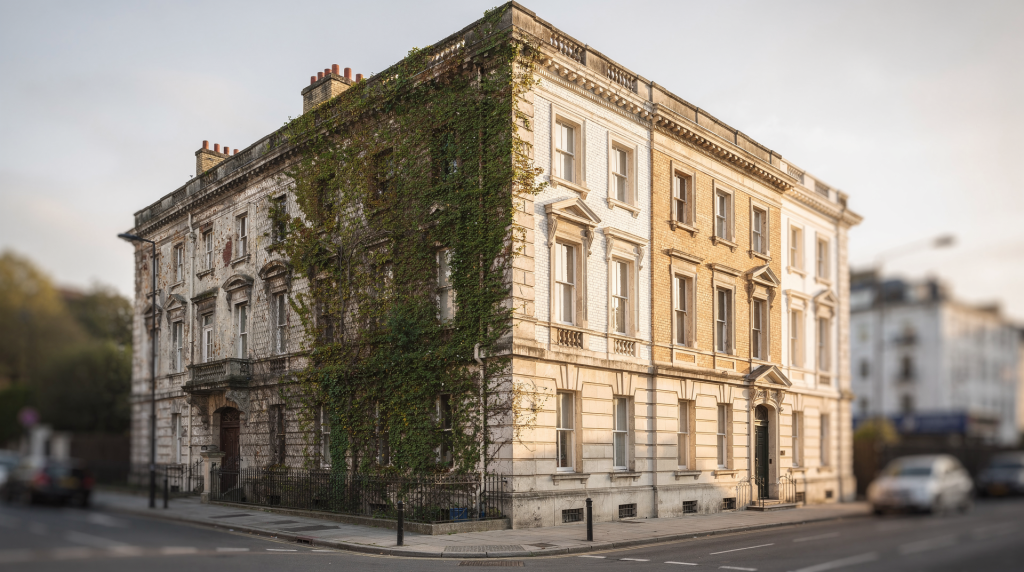
After fifteen years of walking through period houses with surveyors, conservators, and anxious new owners, I have learned that the single most useful conversation happens before anyone picks up a tool. It is the moment when someone asks: are we keeping this building as it is, or are we taking it back to an earlier version of itself? The words for those two paths are preservation and restoration, and they are not interchangeable. Preservation stabilises a historic property in its current state, respecting every layer of change as part of the record. Restoration selects one period of significance and strips away everything that does not belong to it, reconstructing what has been lost.
For anyone responsible for a period property—whether you are the custodian of a listed Georgian townhouse or researching a modest Victorian terrace before work begins—this distinction shapes every decision that follows. It determines what stays, what goes, how you document the process, and how much evidence you risk losing along the way.
What “Historic Preservation” Actually Means
Preservation is fundamentally about maintaining and repairing what is already there. The philosophy is straightforward: the building as it stands is a legitimate historical document, and the job is to keep it stable, authentic, and usable without erasing the marks of time.
When I assess a property with preservation in mind, I am looking at the existing fabric—the original lime plaster that has cracked but not failed, the sash windows with worn pulleys that still function, the later partition that tells you when the house was divided into flats. Preservation asks whether these elements can be repaired rather than replaced, and whether later alterations contribute to the building’s story rather than detract from it.
In practical terms, preservation usually means:
- repairing original windows—splicing new timber into rotten sections, re-puttying, and replacing broken cords—rather than ordering factory-made replicas
- stabilising damaged plaster with lime-based consolidants and stainless-steel fixings instead of stripping it back to the lath
- keeping later, historically relevant alterations if they speak to how the building was used over time
- improving services carefully—discreetly routed electrical conduits, sympathetic heating solutions—so the building stays functional without losing character
A preservation approach accepts that old buildings change. That evolution is not a problem to be erased; it is part of their significance. The 1920s bathroom awkwardly inserted into a Victorian bedroom, the 1950s Crittall window in the rear extension—these are not necessarily mistakes. They are evidence of how people adapted the building to their needs, and that evidence has value.
What “Restoration” Means
Restoration is more selective and, crucially, more interpretive. It aims to depict a building as it appeared during a chosen period of significance. This is not about freezing a building in time so much as editing its timeline—removing features from other eras and reconstructing missing details so that one particular moment reads clearly.
I have worked on projects where restoration was the right call, and I have seen it done badly. The difference lies in the quality of the evidence. A proper restoration project relies on physical investigation—mortice scars that reveal the position of a missing partition, ghost lines on a wall where a dado rail once sat, paint analysis that identifies original colour schemes—backed by historic photographs, drawings, and written descriptions. Without that evidence, restoration becomes guesswork dressed up as authenticity.
A restoration project may involve:
- removing non-original additions that obscure the chosen period
- reinstating original room layouts by reconstructing walls or openings that were altered later
- recreating missing mouldings, shutters, doors, or chimneypieces based on surviving fragments or documentary evidence
- using a combination of physical investigation, archival research, and comparative study of similar buildings to guide every decision
Restoration is not simply “making something look old.” It is a targeted attempt to represent one historical moment more clearly than the building currently does—and that clarity comes at the cost of erasing other moments.
Preservation vs. Restoration: The Key Difference
The simplest way to separate them is this: preservation protects the building as a layered historic record, while restoration reshapes the building to emphasise one chosen period. One values continuity; the other values clarity.
| Aspect | Preservation | Restoration |
|---|---|---|
| Main goal | Keep existing historic fabric and form | Return building to a selected earlier period |
| Treatment of later changes | Usually retained if historically valuable | Often removed if not part of the chosen period |
| Work focus | Maintenance, repair, stabilisation | Removal, reconstruction, selective replacement |
| Historical approach | Values the full timeline of the building | Values one specific moment most strongly |
| Risk | Less loss of original evidence | Greater risk of discarding later history |
I have stood in houses where this distinction became painfully real. In one case, an owner had stripped every later addition from a Victorian villa in the name of restoration, only to discover that the “original” floor plan they had reconstructed was based on a single undated sketch. The 1910 extension they demolished had contained the only surviving evidence of how the service wing operated. That history is now gone.
When Preservation Is the Better Choice
Preservation is usually the better path when the building still has a high level of original fabric, when its later alterations are historically meaningful, or when the evidence is too incomplete to support accurate restoration. It is the more conservative approach, and in conservation terms, that is often a virtue.
Choose preservation when:
- original materials are still largely intact—the floorboards, the joinery, the plaster, the glass
- later layers tell an important story about the building’s use and adaptation over time
- there is not enough evidence to reconstruct an earlier appearance accurately
- the property needs practical repairs more than an aesthetic reset—a leaking roof matters more than a missing cornice
This is often the right approach for houses that have evolved over generations. A Victorian villa with early 20th-century extensions, wartime alterations, and postwar subdivisions may be more valuable as a layered record than as a version of its first floor plan. Each layer documents how people lived in it, and that cumulative story is what makes the building significant.
When Restoration Makes Sense
Restoration works best when there is strong evidence for a clearly significant period and when later changes actively obscure the building’s meaning. It is especially useful when a property has already lost much of its original coherence and the goal is to recover that legibility—to make the building readable again.
Restoration may be appropriate when:
- the building is associated with a major historical phase—a known architect, a significant event, a particular period of design
- photographs, drawings, or physical evidence document the earlier state in detail
- later alterations are intrusive or poorly executed—think 1970s suspended ceilings in a Georgian room
- a heritage body or owner wants a specific interpretive focus, and that focus is supported by solid research
A common example is a room where modern finishes have concealed original joinery, proportions, and decorative detail. I recall a drawing room where layers of wallpaper, hardboard panelling, and emulsion paint had buried the original dado rail, picture rail, and cornice. Physical investigation revealed enough evidence to reconstruct the decorative scheme. Restoration involved removing those later layers and rebuilding the missing elements where the evidence supported it—but we documented every layer before removing it, because even the concealment told a story about changing tastes.
Why the Distinction Matters on a Real Project
The difference between preservation and restoration affects almost every decision on site. It determines whether a cracked sash is repaired or replaced, whether a later porch stays or goes, and whether a worn stone threshold is treated as patina or as damage. These are not abstract questions; they translate directly into specifications, budgets, and contracts.
It also affects:
- project scope and cost—restoration typically involves more research, more specialist labour, and more custom work
- permissions and heritage approvals—conservation officers will want to know which philosophy you are applying and why
- selection of materials and trades—repairing historic fabric requires different skills than replacing it
- how much research is needed before work begins—restoration demands a thorough evidence base; preservation can proceed with careful observation
- whether the building’s “story” remains layered or becomes focused on one period
If this distinction is misunderstood, owners can end up stripping out valuable historic fabric in the name of “restoration” when preservation would have caused less harm and delivered a better result. I have seen original hand-forged ironwork replaced with machine-made replicas because someone thought older meant rougher, and therefore inferior. It did not.
A Practical Decision-Making Framework
Before choosing a treatment, I always work through four questions. They are simple, but they force clarity.
1. What survives?
Identify original materials, later additions, and repairs. Separate genuine historic fabric from modern substitutions. This is the baseline survey—you cannot make decisions about what to keep or remove until you know what is actually there.
2. What is the period of significance?
Decide whether the building’s importance lies in one era or in its accumulated history. Not every building needs to be returned to a single date. A house that was built in 1840, extended in 1890, and altered again in 1930 may be significant precisely because it shows all three phases.
3. What evidence exists?
Look for drawings, photographs, paint analysis, joinery marks, mortices, ghost lines, and archived descriptions. Restoration without evidence quickly turns into guesswork, and guesswork is not conservation—it is decoration.
4. What will be lost?
Consider what later layers contribute to the building’s story. Sometimes the most honest decision is to leave a later alteration in place, not because it is beautiful, but because it is true. Removing it would destroy evidence that cannot be recovered.
Common Mistakes Owners Make
Many problems start with terminology. People say they want “restoration” when what they really need is careful repair and stabilisation. The word sounds more ambitious, more complete—but ambition without evidence is dangerous in a historic building.
Typical mistakes include:
- removing original material because it looks worn—patina is not a defect, and surface wear is part of the building’s biography
- replacing every old feature with new ones for visual neatness—a row of identical new sash windows may look tidy, but it erases the subtle variations that tell you which ones are original and which were replaced after a storm in 1923
- assuming older automatically means better—some later alterations are historically significant in their own right
- restoring to an imagined “original” without evidence—the version of the building that exists in your mind may never have existed in reality
- ignoring the significance of later additions—a 19th-century conservatory added to an 18th-century house is not an intrusion; it is evidence of how the house was lived in and enjoyed
Another frequent error is treating authenticity as perfection. Historic buildings usually carry traces of use, repair, and adaptation. Those traces are often part of their value. A floorboard worn smooth by a century of footsteps is not a problem to be solved; it is a record of human presence.
How to Approach a Historic House Properly
If you own or manage a period property, start with documentation before intervention. The most expensive mistakes I have seen began with someone picking up a hammer before they had picked up a camera or a notebook.
Step-by-step approach
- Record the building as it exists now—photographs, measured drawings, written descriptions.
- Identify surviving original elements—mark them on your drawings so you know what is irreplaceable.
- Map later changes by period—create a chronology of alterations so you understand the building’s evolution.
- Research old plans, images, deeds, and references—local archives, historic England registers, old sale catalogues.
- Decide whether the best treatment is preservation, restoration, or a combination—based on evidence, not preference.
- Match the work to the building’s significance, not to a trend—what is right for one house may be wrong for another.
- Keep a record of every intervention for future caretakers—your decisions will become part of the building’s history.
Quick checklist
- Do I know which parts are original?
- Have I identified the building’s most significant period?
- Is there enough evidence to restore accurately?
- Will removal of later work destroy useful history?
- Can damaged fabric be repaired instead of replaced?
- Are proposed materials compatible with the old structure?
Preservation and Restoration Can Work Together
Real projects are not always pure preservation or pure restoration. Many of the most successful jobs I have seen combine both approaches, applying different treatments to different parts of the building depending on what survives and what the evidence supports.
For example:
- the exterior may be preserved—repaired brickwork, retained later windows—while one significant room is restored to its 18th-century decorative scheme based on paint analysis and physical evidence
- original structure may be retained while later mechanical systems are discreetly upgraded—new plumbing routed through existing chases, heating panels integrated behind original joinery
- non-original partitions may be removed to recover a lost spatial quality, but repaired historic finishes are left in place with their wear and patina intact
This mixed approach is often the most practical option for occupied houses. It protects authenticity while still improving usability—and it acknowledges that buildings are not museum exhibits. They are places where people live, and that living leaves traces worth keeping.
The Role of Authenticity
At the heart of the debate is a simple question: what makes a historic building meaningful? Preservation tends to answer: its surviving fabric and accumulated history. Restoration tends to answer: its appearance at a chosen point in time. Both answers are valid, but they lead to very different outcomes.
Neither approach is inherently superior. The right choice depends on the building, the evidence, and the story you are trying to safeguard. What matters is that the choice is made consciously, with a clear understanding of what will be kept and what will be lost.
For many historic houses, the most responsible work is not dramatic. It is careful, documented, and restrained. That usually means repairing before replacing, studying before changing, and respecting the fact that a building’s history is not a flaw to be erased. The best conservation work is often the kind you cannot see—the repairs that stabilise, the records that endure, the decisions that leave the building’s story intact for the next generation to read.
FAQ
Is restoration always more expensive than preservation?
Not always, but it often requires more research, more specialist labour, and more custom work, especially when missing details must be reconstructed accurately. A preservation repair might involve a skilled joiner splicing new timber into an existing sash; a restoration might require commissioning a complete new window to match a documented original that no longer exists.
Can a building be both preserved and restored?
Yes. Many projects preserve the overall structure while restoring specific rooms, features, or elevations. The key is being explicit about which approach applies where, and why.
Is replacing old materials considered preservation?
Usually no. Preservation prioritises maintenance and repair of existing historic materials, not widespread replacement. If a material is beyond repair, like-for-like replacement may be necessary, but the default position is to repair first.
Does restoration remove all later additions?
Not necessarily all, but it often removes later features that are outside the chosen period of significance. The scope depends on how clearly the building is meant to represent that period.
Which is better for a listed or protected building?
That depends on the building’s significance, condition, and available evidence. In many cases, preservation is the safer and more defensible starting point—it protects what survives while leaving open the possibility of future restoration if better evidence emerges.
Conclusion
The difference between preservation and restoration is not just vocabulary. It is a decision about how much of a building’s history you keep, how much you remove, and how honestly you represent its past. Every historic building carries multiple stories—of its construction, its alterations, its repairs, its changing uses. Preservation tends to keep those stories legible; restoration tends to edit them for clarity.
If the building is rich in original fabric and meaningful later layers, preservation usually protects more value. If a clear period of significance is supported by solid evidence, restoration can recover lost character and make the building readable again. The best projects begin with research, respect the surviving material, and treat historic houses as documents as much as buildings—texts to be read carefully before any word is erased.