Why Historic Buildings Matter to Their Communities
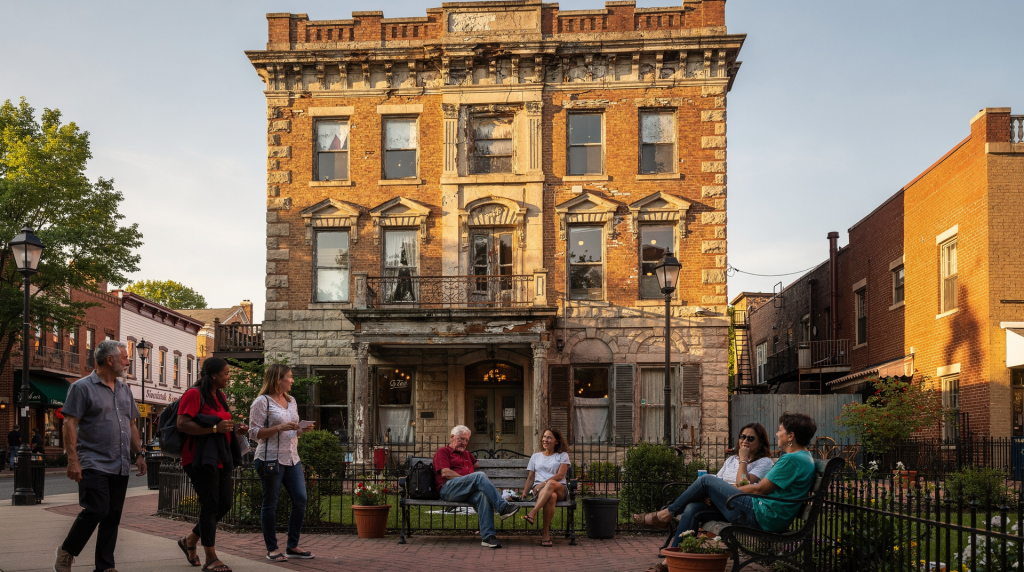
Walk through any town that has kept its older buildings, and you feel it immediately: a texture, a weight, a sense that the place has been lived in for generations. This is not nostalgia. It is the accumulated evidence of decisions made by people who are no longer here—about materials, proportions, street lines, and what deserved to face the public square. Historic buildings give a community something that cannot be manufactured quickly: memory embedded in brick, stone, timber, and glass.
For communities, the value of a historic building is rarely only architectural. It is social, cultural, and practical at the same time. A Georgian terrace is not just a row of houses; it is a record of speculative building, class structure, and the way light falls on a particular street at four o’clock in the afternoon. A Victorian chapel is not merely a religious structure; it is evidence of nonconformist history, local philanthropy, and the acoustic properties of lime plaster. These layers accumulate, and they matter.
The real role historic buildings play in a community
A historic building is often one of the few physical places where a town or neighborhood can still read its own story. It shows how people lived, worked, worshipped, traded, and built over time. When I walk through a market town in the Midlands or a former mill village in Yorkshire, I look for the buildings that explain the place: the warehouse with taking-in doors on every floor, the terrace with stone lintels from a local quarry, the pub with a yard that once held livestock for the weekly market. These are not museum pieces. They are the surviving pages of a long narrative.
That matters because communities are not built only from roads and housing stock. They are also shaped by shared landmarks, familiar streetscapes, and places people return to year after year. Remove those landmarks, and you do not just lose buildings—you lose the ability to locate yourself in time.
1. They create a sense of place
A strong sense of place is one of the most important reasons historic buildings matter. These buildings make a town feel distinct rather than generic. I have stood in too many town centers where the only difference between one high street and another is the name on the coffee chain. Historic fabric resists that sameness. It preserves scale, materials, craftsmanship, and street patterns that newer construction often lacks—not because new construction is inherently worse, but because modern development economics rarely allow for the same depth of detail, the same idiosyncratic response to site and climate.
That visual continuity helps residents recognize their surroundings as part of a larger local identity. When you know that the gable end on the corner has looked that way since 1780, the street becomes more than a route from A to B. It becomes a place with a biography.
What this means in practice
- People can navigate a place more easily because it feels legible and familiar—the church spire, the clock tower, the curved shopfront all serve as wayfinding tools that no signage can replicate.
- Local landmarks become reference points for memory and daily life: where you met, where you celebrated, where you sheltered from rain.
- Neighborhood character becomes something residents can describe and defend, because they can point to specific qualities—the brick bond, the roof pitch, the rhythm of windows—rather than vague feelings.
2. They strengthen local identity and pride
Historic places often become symbols of belonging. A courthouse, mill, house, school, chapel, or warehouse can represent much more than its original use. I have seen this repeatedly: a redundant Nonconformist chapel that no longer holds services but remains fiercely protected by a community that sees it as the marker of their ancestors’ independence. A cooperative store that still carries the date stone and the ethos, even if the business model has changed.
Communities often attach meaning to these buildings because they connect current residents to earlier generations. That connection creates pride, especially when a place has survived neglect, redevelopment pressure, or disaster. There is something powerful about knowing that a building weathered the same economic storms, the same changing fashions, the same threats of demolition that could have erased it—and it is still standing.
Common examples of identity-building places
- Civic buildings that represent local government and public life—town halls, guildhalls, courthouses—where decisions were made that shaped the community’s trajectory.
- Industrial buildings tied to labor history: mills, breweries, workshops, warehouses that carry the physical marks of the trades they housed.
- Houses linked to notable local families or events, where the connection is not necessarily architectural grandeur but associative meaning.
- Religious buildings that anchor long-standing communities, even when congregations have shrunk or merged.
- Main streets that reflect trade, migration, and everyday life—the butcher’s shop with its original glazed tiles, the post office with its Edwardian counter.
3. They support education and public understanding
Historic buildings are open-air history lessons. They let people see construction methods, social hierarchies, decorative tastes, and changes in technology in a way books cannot fully replace. You can read about Georgian sash windows, but until you have lifted one and felt the weight of the counterbalance, you do not fully understand the ingenuity of the system. You can study Victorian philanthropy, but standing in a model lodging house designed by a Quaker reformer makes the intentions tangible.
For children, students, and visitors, these places make history concrete. They also help communities tell fuller stories, including difficult or overlooked ones. A country house is not just a celebration of architecture; it is also a record of the labor that built and maintained it, the wealth that funded it, and the social structures it reinforced. A workhouse building is uncomfortable heritage, but it is essential evidence.
Why this matters
- History becomes visible rather than abstract—you can trace the change from hand-made brick to machine-pressed, from crown glass to cylinder glass, from timber lintels to cast iron.
- Local museums and heritage groups gain stronger teaching tools; the building itself becomes the primary source.
- Residents better understand how their community developed—why the railway came through this valley, why the housing stock looks the way it does, why certain industries clustered here.
4. They can help local economies
Preservation is not only cultural; it can also be economically useful. I have watched this play out in market towns where a well-maintained historic core becomes the reason visitors choose to stop rather than drive through. Historic districts and well-kept heritage places attract visitors, support local businesses, and strengthen downtown areas. The independent bookshop, the cheesemonger, the gallery—they cluster where the buildings have character because the setting adds value to the experience.
Heritage tourism often brings people who stay longer and spend money in restaurants, shops, lodging, and cultural attractions. These are not typically the visitors looking for a quick photo; they are the ones who book a guided walk, visit the local museum, and ask about the history of the building they are sleeping in. In many places, historic areas also help recruit businesses because they create an appealing setting and a recognizable identity that no corporate campus can replicate.
Economic benefits often seen around historic buildings
| Benefit | How it shows up |
|---|---|
| Tourism | Visitors come for architecture, history, and events—and they tend to stay longer than day-trippers to generic attractions. |
| Business activity | More foot traffic for nearby shops and services, particularly independent retailers who benefit from the browsing behavior heritage visitors exhibit. |
| Property confidence | Stable historic districts can support long-term investment; buyers often pay a premium for period character when it is protected by conservation area status. |
| Downtown vitality | Older commercial buildings often anchor walkable centers, providing the fine-grained urban fabric that supports diverse uses at street level. |
5. They encourage social cohesion
Historic buildings can bring people together because they are shared reference points. A saved theater, market hall, church, or school often becomes a place for gatherings, volunteer work, exhibitions, and public discussion. I have seen a derelict chapel become a community cinema, a redundant town hall become a coworking space, a closed pub become a village shop run by volunteers. The building provides the container; the community provides the life.
That shared use matters. When residents participate in decisions about preservation—attending consultation meetings, contributing to funding campaigns, helping with research—they often feel more invested in the future of the place. Preservation can therefore support not only buildings, but also community trust and cooperation. The process of saving a building can be as socially valuable as the building itself.
6. They contribute to continuity during change
Communities change constantly through new development, population shifts, and economic pressure. Historic buildings help prevent that change from erasing everything familiar. They act as anchors in a shifting landscape. When a town loses its industry, its historic fabric often becomes the foundation for reinvention—think of textile mills becoming apartments and workspaces, or dock warehouses becoming galleries and restaurants.
Continuity is especially valuable after disruption. A preserved building can give residents a point of recognition when other parts of the built environment have changed quickly or been damaged. After the Second World War, many European cities rebuilt around their surviving historic monuments because those buildings provided psychological as well as physical orientation. In that sense, historic places offer stability without freezing a community in time. They are not about preventing change; they are about ensuring change does not sever the connection to what came before.
7. They preserve craftsmanship and local materials
Historic buildings are also records of building skill—and this is something I look at closely whenever I visit a property. Timber framing, brickwork, ironmongery, joinery, plasterwork, and stone carving all tell us about local labor, available materials, and regional construction traditions. The brick bond in a Suffolk cottage is different from that in a Lancashire terrace, and both are different from the stone coursing in a Cotswold farmhouse. These are not accidental variations; they are evidence of what was to hand and who knew how to work it.
That craftsmanship has community value because it keeps knowledge visible. When a young apprentice watches a conservation joiner repair a sash window with the same scarf joint used two hundred years ago, a skill survives. When these buildings are repaired well, they also support trades that depend on specialist repair skills rather than replacement. The lime plasterer, the stone mason, the leadworker, the iron founder—these are not obsolete trades. They are essential to keeping historic fabric alive, and their economic value to a community is real.
What communities lose when historic buildings disappear
When a historic building is demolished without serious review, the loss goes beyond the structure itself. I have walked past sites where a building stood for two hundred years and found nothing but a gap, a hoarding, and the faint outline of a gable on the neighboring wall. Communities lose a shared landmark, evidence of local history, architectural variety, tourism appeal, embodied craftsmanship, and public memory—all at once.
Once a building is gone, its material evidence is gone too. Photographs can document it, but they cannot replace the texture, scale, or physical presence that made it part of everyday life. You cannot photograph the way a stone step wears underfoot, the way a door handle feels after a century of hands, the way light falls through crown glass at a particular hour. These are experiential losses, and they accumulate.
How to assess why a historic building matters locally
If you are evaluating a building’s community value, ask practical questions rather than relying only on age. Age alone is a poor measure of significance. I have seen unlisted 1930s semis that mattered more to their neighborhood than a Grade II listed structure nobody used or noticed. The question is not “how old is it?” but “what does it do for this place?”
Checklist for community significance
- Is it a recognized local landmark—do people use it to give directions, meet friends, or describe where they live?
- Does it represent an important period in the town’s development—the canal era, the railway boom, postwar reconstruction?
- Is it linked to people, industries, or events residents still remember and talk about?
- Does it contribute to a historic street or district, where its loss would break the visual or spatial rhythm?
- Is it used by the public or visible in daily life, even if only from the street?
- Does it have rare architectural details or construction methods that are locally or regionally significant?
- Would its loss create a gap in the story of the place—a missing chapter that cannot be filled by anything new?
A building does not need to be grand to matter. A modest terrace, corner shop, barn, chapel, or school can be just as important if it carries local meaning. Some of the most fiercely defended buildings I have encountered were not architecturally distinguished; they were simply the places where ordinary life had unfolded for generations.
When preservation is challenged
Not every old building can be saved in its current form. Communities often face real limits: maintenance costs that outstrip available funding, structural failure that makes retention unsafe, unsuitable modern use that cannot be reconciled with the original layout, and development pressure that makes demolition economically attractive. I have seen all of these, and I have learned that blanket opposition to change is rarely helpful.
The practical question is not “old versus new.” It is whether change can happen without destroying the qualities that give a place its identity. Good outcomes often come from repair, sensitive adaptation, and careful reuse rather than simple preservation in amber. A building that has been thoughtfully converted—where the original staircase remains, where the brickwork is cleaned rather than painted, where new interventions read honestly as new—can serve its community better than one left to decay under a preservation order nobody can fund.
A practical way to think about historic value
A useful rule, refined over years of looking at buildings and listening to the people who care about them, is this: the more a building contributes to local memory, daily use, and visual character, the more it matters to the community. This is not a formula you can apply mechanically, but it is a reliable lens.
That includes buildings that anchor a main street, tell an underrepresented story, support local jobs or tourism, give residents a sense of continuity, and embody regional craftsmanship. It also includes buildings that do none of these things yet but could, with the right intervention. Sometimes the value is latent, waiting for a use that unlocks it.
Conclusion
Historic buildings matter because they make communities recognizable, meaningful, and connected to their past. They support identity, learning, cohesion, and local economies, while preserving the physical evidence of how a place grew and changed. They are not obstacles to progress; they are the record of progress already made, the material proof that communities have adapted before and can adapt again.
For communities, saving historic buildings is not nostalgia. It is a way of protecting memory, character, and the everyday places that make a town worth knowing. The question is never just “should we keep this building?” It is “what kind of place do we want to be, and what do we need to keep in order to remain that place?”
FAQ
Why are historic buildings important to communities?
They preserve local identity, support pride, teach history, and help create a distinctive sense of place. They are the physical evidence of how a community developed, and they provide continuity across generations.
Do historic buildings have economic value?
Yes. They can support tourism, local business activity, downtown vitality, and property confidence in historic districts. Heritage visitors tend to stay longer and spend more, and historic areas often attract businesses seeking distinctive settings.
Are only famous buildings worth saving?
No. Modest buildings can be just as important if they are tied to local memory, daily life, or a significant part of the community’s history. A corner shop, a chapel, or a terrace can carry more local meaning than a nationally listed landmark.
What makes a historic building valuable to residents?
Its value often comes from recognition, shared memory, architectural character, and the role it plays in everyday life. A building that people see daily, use regularly, or remember fondly has a value that goes beyond architectural merit.
Can preservation and development work together?
Yes. In many cases, the best approach is sensitive reuse and repair, so a building keeps its character while serving a current need. The most successful projects treat the historic fabric as an asset rather than a constraint.